
Speaking during the opening ceremony, Prof. Benedict Alala observed that the training represents a convergence of professional expertise and social responsibility, aimed at enhancing eye healthcare services, promoting inclusivity, and improving the quality of life of persons living with visual impairment. “Visual impairment and low vision present profound challenges that extend far beyond clinical metrics, as they deeply impact personal autonomy, social integration, and economic productivity. In this context, orientation and mobility training emerges not only as a clinical rehabilitation tool, but also a gateway to human dignity. By equipping individuals with the skills, spatial awareness, and confidence to navigate their environments safely and independently, we are dismantling barriers and restoring the promise of self-reliance,” read the DVC PRI’s speech.
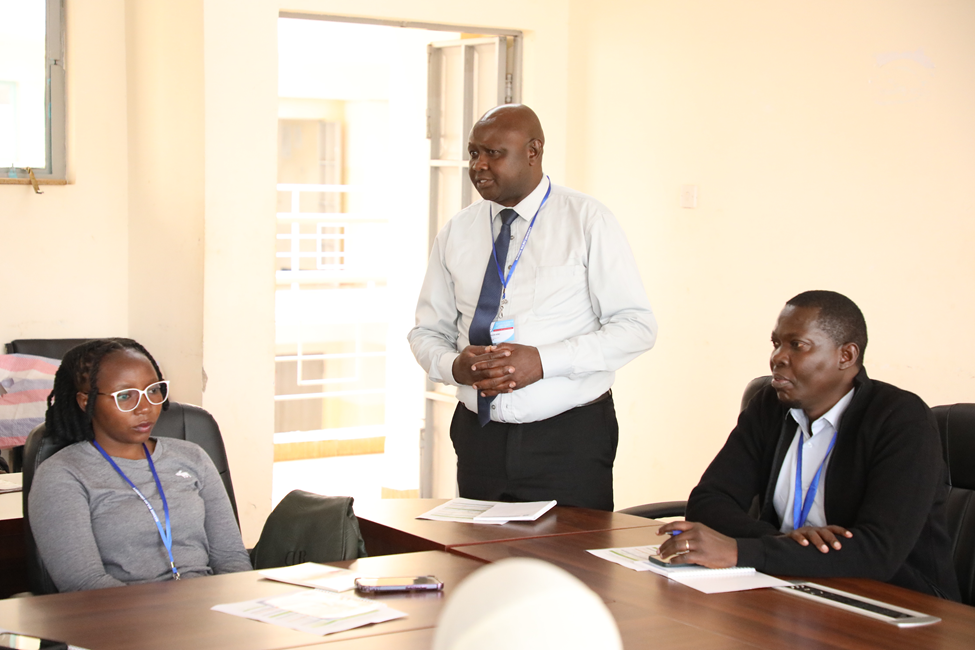
The Chairperson of the Department of Optometry and Vision Sciences, Dr. Julius Rono making his remarks.
The Chairperson of the Department of Optometry and Vision Sciences, Dr. Julius Rono noted that while eye care professionals in Kenya have made great progress in diagnosing and managing visual impairment, limited attention has been given to rehabilitation after vision loss. He explained that the training was designed to equip practitioners with practical skills to help persons with low vision adapt to their environments, perform daily activities independently and improve their overall quality of life. Dr. Rono further revealed that MMUST has an existing Memorandum of Agreement with the University of Valencia and is in the process of formalizing similar collaborations with the Universities of Costa Rica and Madrid.
“MMUST is keen on collaborating with institutions of higher learning across the globe. Through these partnerships we network, learn and exchange knowledge with experts in various fields, thereby strengthening our capacity as a University to provide solutions to challenges affecting our communities. I am confident that our collaborations with the Universities of Valencia, Costa Rica and Madrid, will open up more opportunities for staff and student exchange programmes, further enhancing our institutional growth as well as communities,” said Dr. Rono.
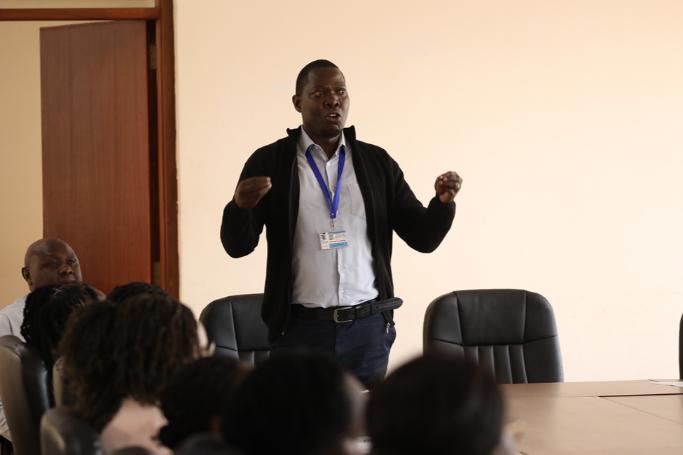
The Director of Short Courses and Webometrics, Dr. Dennis Ochieno speaks at the event.
On his part, the Director of Short Courses and Webometrics, Dr. Dennis Ochieno stressed that visual impairment is a universal human challenge that could result from ageing, congenital conditions, accidents, or disease. He urged eye care professionals to look beyond clinical interventions and address the social and cultural barriers that discourage many people from seeking vision care.
“This training is one of the flagship programmes under the Directorate of Short Courses. I applaud the diversity of participants drawn from different countries and continents. It has provided an excellent opportunity for networking and learning from our international collaborators while appreciating the latest advancements in low vision rehabilitation,” remarked Dr. Ochieno.
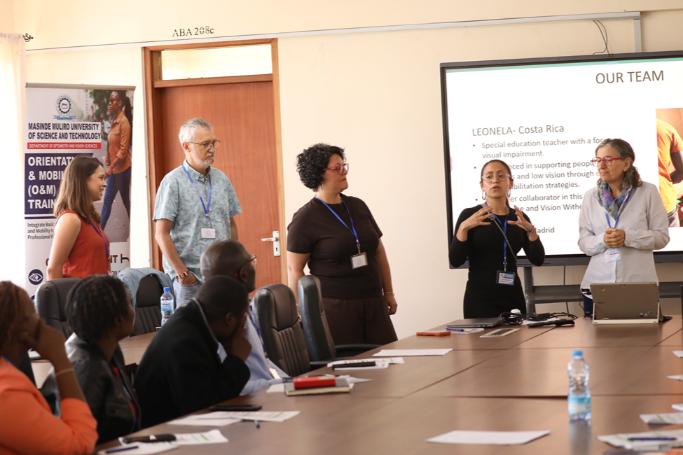
Standing (from right) Dr. Isabel Signes (University of Valencia and an Adjunct Researcher at MMUST); Dr. Leonela Gonzalez (University of Madrid and Costa Rica); Dr. Isabella Fambuena (University of Valencia); Dr. Jose Luis Hernandez (University of Madrid) and Dr. Amparo Gil (University of Valencia) during the event.
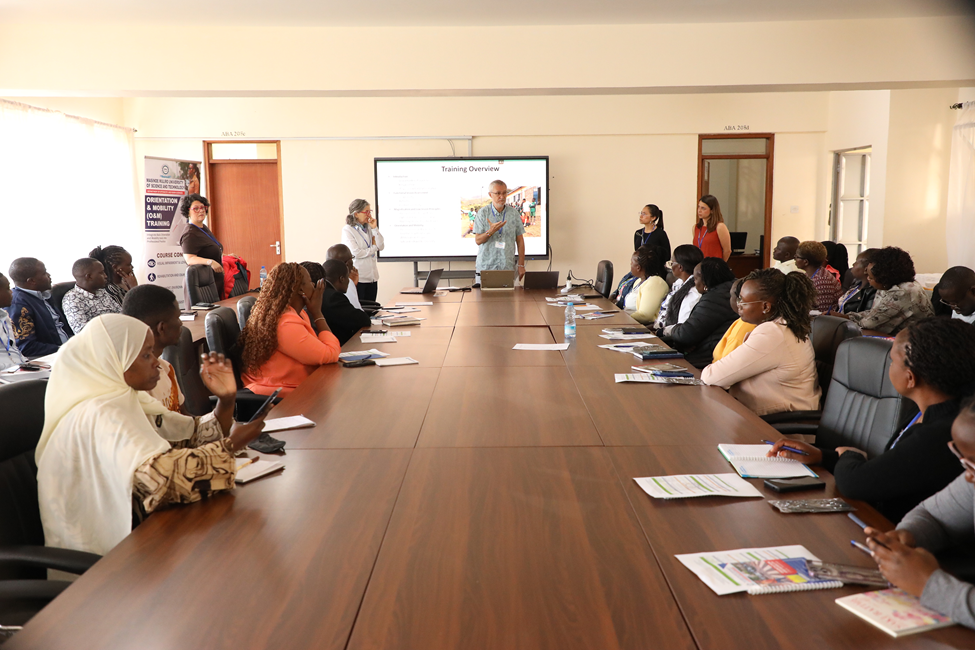
Notably, the training featured presentations by five international facilitators from the Universities of Valencia, Madrid and Costa Rica. Some of the topics covered included, ‘Basics of Low Vision: Definitions, assessments, Magnification and Prescription of Visual Aids’ by Dr. Isabel Signes: ‘Basic Functional Rehabilitation in Visual Impairment: Definition and Intervention Areas’ by Dr. Leonela Gonzalez: ‘Introduction to Orientation and Mobility: Definition, Theoretical Aspects, Principles and Intervention Areas’ by Dr. Isabella Fambuena and Dr. Amparo Gil, and ‘Environmental Adaptations, Body Awareness and Motor Foundations, Spatial Orientations, and Prerequisite Concepts, Sensory Skills’ by Dr. Jose Luis Hernandez.
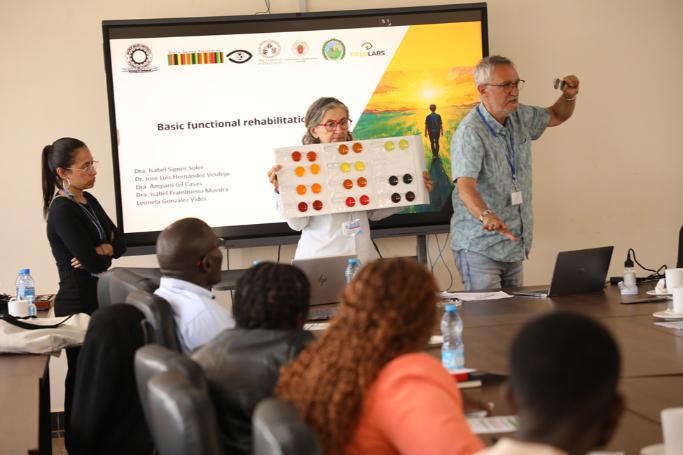
Low vision specialists demonstrating during one of the sessions.
Participants also engaged in practical sessions covering cane and non-cane mobility techniques, tactile mapping, cane repair, environmental navigation and strategies for daily living. It is worth noting that on the final day of the programme, the participants visited Kibos School for the Blind, where they conducted practical demonstrations and applied orientation and mobility techniques in a real life learning environment.
Certainly, this training is expected to enhance the knowledge and practical competencies of eye care professionals, hence contributing to improved rehabilitation services and greater independence for persons living with low vision across Kenya.
Story by Caren Nekesa, Fredrick Ekesa and Sarah Mulyungi
Photos by Shiundu Masafu and Gerald Steve